

Managing several prescriptions can turn into a monthly chore. Between keeping track of pills, arranging refills, and making trips to the pharmacy, older adults and their families can spend considerable time making sure nothing gets missed.
Amazon Pharmacy offers a service that could make that routine easier. Eligible Medicare customers can receive medications organized into labeled packets, while trusted family members can help manage prescriptions remotely.
The service itself has no additional fee, but insurance rules and medication costs still matter. Here is what Amazon offers, who qualifies, and what to check before signing up.
What Amazon Actually Introduced for Older Adults

Amazon Pharmacy expanded two important services on June 3, 2025, aimed at making prescription management easier for older adults and family caregivers.
The first change allowed Medicare Part D beneficiaries to use PillPack, Amazon’s prescription service that sorts medications into individual packets according to when they should be taken.
The second introduced a caregiver feature that lets customers give trusted people access to help manage medications through separate Amazon Pharmacy accounts.
These changes were introduced in 2025, not November 2026. However, they remain available in 2026, alongside Amazon Pharmacy’s expanding prescription delivery network.
The goal is to reduce the work involved in organizing medications, requesting refills, and coordinating prescriptions across different schedules.
For someone managing several daily prescriptions, having medications prepared in advance could eliminate a task that normally requires time and careful attention.
Here is what Amazon’s service provides.
| Feature | What It Offers | Cost or Requirement |
|---|---|---|
| PillPack | Medications sorted by date and time | No additional service fee |
| Home delivery | Recurring prescription shipments | Free PillPack delivery |
| Medicare Part D | Insurance can be used for eligible prescriptions | Plan costs still apply |
| Caregiver access | Trusted adults help manage medications | Free |
| Pharmacist support | Access to licensed pharmacists | Available 24/7 |
| Automatic refills | Eligible medications renewed on a schedule | Generally every 30 days |
The central benefit is convenience rather than guaranteed savings. A customer may spend less time organizing medications while still paying the same prescription copays, or potentially more if the refill schedule changes.
How Amazon’s PillPack Service Actually Works
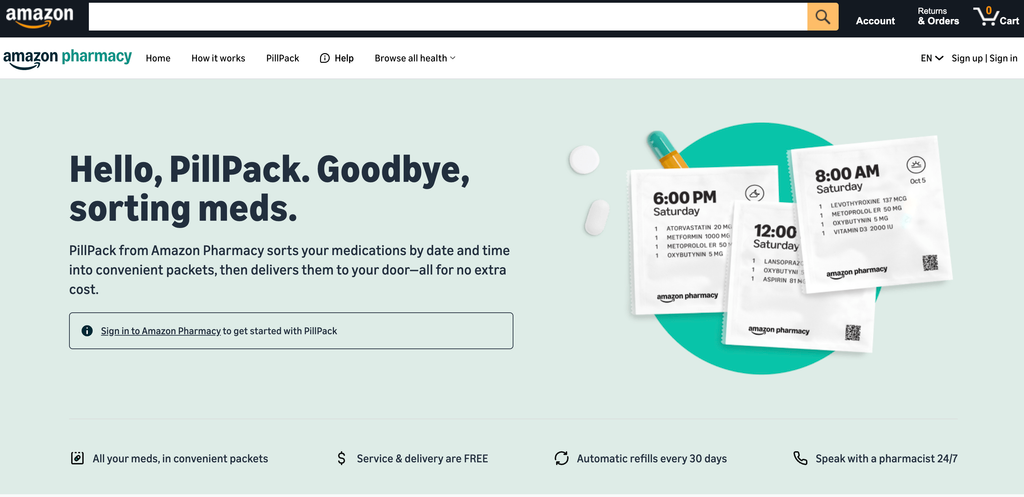
PillPack replaces the need to organize eligible medications from several prescription bottles into daily pill organizers.
Instead, Amazon Pharmacy prepares individual packets containing the medications scheduled for a particular time.
For example, someone taking two medications in the morning and another after dinner may receive separate packets labeled for those dosing times.
Each packet identifies when the medications should be taken. The customer opens the appropriate packet according to the prescribed schedule.
Amazon coordinates eligible refills so medications can arrive together rather than requiring separate pharmacy trips throughout the month.
What Arrives at the Door
Customers receive their medications in secure shipping packaging containing organized packets. Amazon also provides a medication list showing the drugs and their dosing instructions.
The service is designed for people who take at least two recurring eligible prescriptions. It can be particularly useful when those prescriptions are taken at different times.
The packets are prepared by the pharmacy, with pharmacists reviewing medication information before orders are shipped.
However, not every medication can be included. Some prescriptions must still arrive in bottles or their original packaging.
During the first few months, medications may also arrive separately while Amazon coordinates different refill dates.
Why This Could Make a Difference for Retirees

Consider a hypothetical 73-year-old retiree who takes five medications each day.
Two are scheduled for breakfast, another is taken in the afternoon, and two are scheduled for bedtime.
Previously, that person may have organized pills into a weekly container, checked remaining supplies, and requested refills at different times.
With PillPack, eligible medications can arrive organized by dosing time, reducing much of that preparation.
The benefit is not simply avoiding trips to the pharmacy. It is also reducing the number of small tasks involved in maintaining a medication routine.
For family caregivers, that can be valuable when they live in another city or have demanding work schedules.
But pre-sorted medication packets do not guarantee that doses will be taken correctly. Customers still need to follow their prescriptions and review any medication changes with their healthcare professionals.
Who Can Use Amazon’s New Medicare Pharmacy Service?
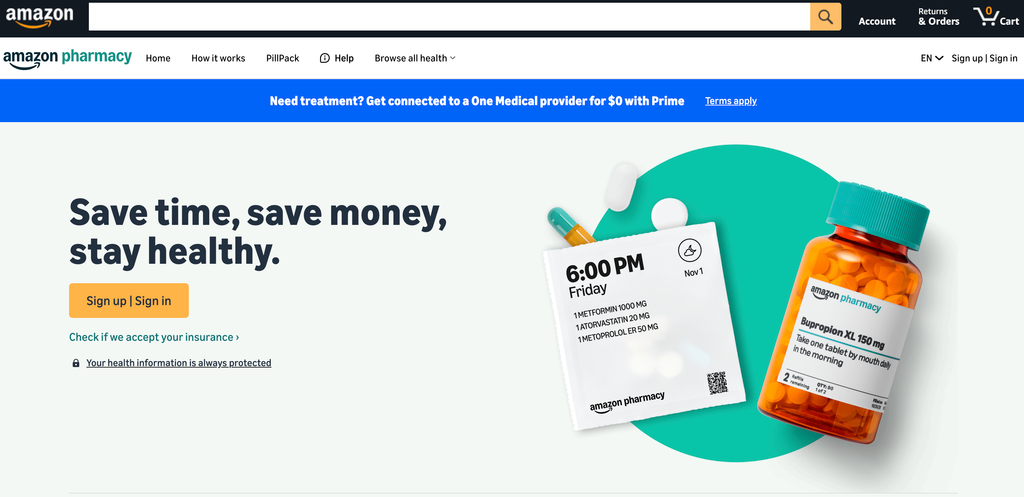
One of the important changes was expanding access to people with Medicare Part D prescription drug coverage.
Before that expansion, Medicare users did not have the same access to the integrated PillPack service now offered through Amazon Pharmacy.
Amazon’s announcement opened the option to a much larger group of Medicare beneficiaries who manage recurring prescriptions.
However, having Medicare does not automatically mean every medication or insurance plan will work with PillPack.
| Customer Situation | Can They Use It? | Important Condition |
|---|---|---|
| Medicare Part D beneficiary | Generally yes | Plan and medication eligibility |
| Medicare Advantage with drug coverage | May qualify | Confirm pharmacy network |
| Private insurance customer | Generally yes | Insurance and prescription eligibility |
| Medicaid beneficiary | May qualify | State and refill restrictions |
| Customer without insurance | May qualify | Pays applicable medication prices |
| Customer taking one prescription | Not eligible for PillPack | Can use standard Amazon Pharmacy |
Amazon Pharmacy accepts most major insurance plans, including Medicare Part D, but customers should verify their specific plan before transferring prescriptions.
Some plans charge less when prescriptions are filled at preferred pharmacies. Others have restrictions involving mail delivery or automatic refills.
This means a service that looks free on the surface may have different prescription costs from a customer’s existing pharmacy.
Does Amazon PillPack Cost Anything?

The PillPack service itself has no additional charge. Customers do not pay a separate fee for medication sorting or its regular delivery service.
They still pay whatever applies to the medications themselves, including insurance copayments, coinsurance, deductibles, or cash prices.
A person with several inexpensive generic medications may find PillPack affordable. Someone taking costly brand-name prescriptions may still face significant monthly expenses.
There is also an important distinction between the cost of the service and the cost of switching pharmacies.
Amazon cannot guarantee that a customer’s existing Medicare plan will provide the same copay at Amazon Pharmacy as it does at a preferred local pharmacy.
For that reason, comparing actual medication prices is essential.
The Cost That Can Surprise Medicare Customers
PillPack operates on a 30-day refill schedule. This may be different from a customer’s current 90-day prescription arrangement.
Some Medicare plans charge less per month for a 90-day supply than they do for three separate 30-day fills.
Here is a hypothetical example involving four recurring prescriptions.
| Expense | Current Pharmacy | Amazon PillPack |
|---|---|---|
| Supply per refill | 90 days | 30 days |
| Copay per medication | $15 | $8 |
| Annual cost per medication | $60 | $96 |
| Annual cost for 4 medications | $240 | $384 |
Illustrative figures only. Actual copays depend on the customer’s medications, insurance plan, and pharmacy.
In this example, switching to monthly fills would increase annual prescription expenses by $144.
The additional expense is not a PillPack service fee. It results from different insurance cost sharing for shorter prescription supplies.
For someone living on a fixed retirement income, even a modest increase deserves attention.
On the other hand, if the same medications have equal monthly costs at both pharmacies, PillPack may offer convenience without an additional prescription expense.
The key is to compare a full year’s costs, not just the first month’s bill.
How Medicare Part D Works With Amazon Pharmacy

Medicare Part D helps pay for eligible outpatient prescription medications. It is available through standalone prescription drug plans and Medicare Advantage plans that include drug coverage.
Amazon Pharmacy can process eligible prescriptions through participating Medicare Part D insurance plans.
However, the amount a person pays depends on their plan’s drug list, pharmacy network, cost sharing, and coverage rules.
For example, one drug might have a small copay at a preferred pharmacy but a higher copay at another participating pharmacy.
A person should therefore check whether Amazon Pharmacy is treated as a preferred, standard, or out-of-network pharmacy under their particular plan.
Medicare’s 2026 Prescription Spending Limit
Medicare introduced an annual out-of-pocket spending limit for covered Part D medications, which is $2,100 in 2026.
Once an eligible beneficiary reaches this limit through qualifying spending, there is no additional copayment or coinsurance for covered Part D drugs for the rest of the calendar year.
The limit does not mean every prescription is covered. It also does not include Part D plan premiums or purchases made outside the applicable Part D benefit.
That distinction matters when comparing Amazon’s insurance prices with its separate cash discount programs.
A cheaper cash purchase may reduce the amount paid immediately but generally will not count toward the Medicare Part D deductible or annual out-of-pocket maximum.
Customers should also review their next year’s plan because drug coverage, pharmacy networks, and costs can change annually.
What About Amazon’s $5 Prescription Subscription?

Amazon Pharmacy also offers RxPass, a separate prescription subscription program for eligible Amazon Prime members.
RxPass provides access to a selected list of common generic medications for a flat $5 monthly subscription fee.
The fee covers eligible medications on the RxPass list, rather than every prescription a person takes.
Medicare beneficiaries can be eligible for RxPass, subject to its terms, but the program is not insurance and cannot be combined with Medicare Part D payment for the same prescription.
This means a retiree should compare the RxPass price against what the medication costs through their existing coverage.
How Much Could RxPass Save?
Consider a hypothetical retiree who already has Prime and pays $12 each month for eligible generic medications without using insurance.
That equals $144 over a year.
If all those medications qualify for RxPass and the customer is eligible, the $5 monthly subscription would total $60 annually.
The potential difference would be $84 a year, before considering any other changes or costs.
However, someone who pays only $2 each month through Medicare for the same medications could spend more by using RxPass.
The right option depends on the specific prescriptions and insurance benefits.
| Payment Option | Basic Cost | Main Consideration |
|---|---|---|
| Medicare Part D | Plan-specific copays or coinsurance | Qualifying costs count toward Part D limits |
| PillPack with insurance | Applicable medication costs | No extra sorting fee |
| RxPass | $5 monthly plus Prime membership | Only eligible generic medications |
| Amazon cash pricing | Price varies by prescription | Savings are not Medicare insurance |
| Local preferred pharmacy | Plan-specific pricing | May offer lower copays |
RxPass is available only to eligible Prime members and is subject to state and insurance restrictions. It is not available for shipping to California or Washington, and people with certain state-funded insurance programs cannot enroll.
For many retirees, the most valuable first step is comparing what they already pay with what Amazon would charge for the same medications.
A New Feature Lets Adult Children Help Their Parents

Amazon’s caregiver feature may be especially useful for families who share responsibility for managing prescriptions.
An older adult can invite a trusted family member or another person to help manage medications through Amazon Pharmacy.
That individual uses their own Amazon Pharmacy account rather than signing in with the older adult’s password.
After verification, a caregiver may help coordinate prescriptions, request refills, review orders, and update relevant pharmacy information.
This can be useful for adult children who live away from their parents.
For example, a daughter living in another state may be able to check whether her father’s prescriptions are due for renewal without asking him to provide account passwords.
The arrangement does not mean the parent loses control over their pharmacy account.
How to Give a Family Member Access
The person receiving care begins the process from their Amazon Pharmacy settings.
They can open the Manage Health Access section and select the option to invite someone to help.
After entering the trusted person’s name and mobile number, Amazon sends an invitation that the recipient must accept.
The invited person completes verification and can then manage the permitted pharmacy tasks through their own account.
According to Amazon’s current caregiver information, adults can authorize up to six helpers. An adult can also remove a caregiver’s access through their account settings.
This is particularly important because shared access includes sensitive information involving prescriptions, health records, pharmacy orders, payment details, and delivery information.
Families should discuss exactly what help is wanted before sharing access. The older adult remains central to decisions about their medications whenever they are able to make those decisions.
Can Caregivers Manage Everything?

The caregiver feature makes pharmacy administration easier, but it does not give someone unlimited authority over another person’s healthcare.
A trusted helper can assist with permitted pharmacy account activities. Medical decisions, prescribing instructions, and changes to treatment still belong with the appropriate healthcare professionals and the patient.
Caregivers should not independently change a medication dose, stop a prescription, or combine drugs simply because a medication packet or refill seems incorrect.
If a question arises, the safest next step is to contact the prescribing clinician or pharmacist. It is also important to review who has access to the pharmacy account from time to time.
Families may find that one trusted helper is sufficient, even though Amazon allows more than one.
Not Every Medication Can Go Into a PillPack

One limitation is that PillPack is designed mainly for eligible medications taken orally in pill form.
Many common tablets and capsules can be included, but certain medications require separate packaging or handling.
Amazon identifies several types that cannot be placed into PillPack packets, including controlled substances, refrigerated products, certain blister-packed drugs, dissolvable tablets, and some chewable or gummy formulations.
Some vitamins and over-the-counter products may be eligible, but customers should verify their availability.
These restrictions matter because someone may still need to manage two different medication delivery systems.
For example, a retiree with four eligible daily tablets and a refrigerated medication may receive the tablets in PillPack packets while the refrigerated medication arrives separately.
The service therefore reduces part of the medication management process rather than necessarily handling everything.
The Packaging Safety Issue Families Should Know
PillPack medication packets are not child resistant. That is an important consideration in homes where young grandchildren or other children visit.
Medications must still be stored securely and kept out of children’s reach.
Another limitation is that current PillPack packets and medication lists are available only in English, even though other Amazon Pharmacy services have expanded their Spanish-language support.
Families should consider whether the packaging is appropriate for the person receiving it.
If reading labels, opening packets, or following complex dosing instructions is difficult, a pharmacist or healthcare professional can help evaluate whether this system is suitable.
How to Sign Up for Amazon PillPack
Getting started requires an Amazon Pharmacy account and at least two recurring prescriptions that qualify for the program.
The customer can begin the process through Amazon Pharmacy’s official website or application.
- Create or sign in to Amazon Pharmacy. Provide the requested information and add current insurance details if applicable.
- Add existing prescriptions. Ask a healthcare provider to send prescriptions to Amazon Pharmacy or request a transfer from the current pharmacy.
- Choose PillPack. Select the Sign Up for PillPack option and review the list of eligible prescriptions.
- Review payment preferences. Confirm the insurance information, expected medication prices, and delivery address.
- Confirm the refill schedule. Review the 30-day arrangement and the expected arrival date before completing registration.
- Check the first shipment. Compare the medications received with the current prescriptions and contact a pharmacist about any discrepancy.
For Medicare and other government insurance beneficiaries, a medication generally must be filled once through Amazon Pharmacy before it can be added to automatic PillPack refills.
This means the first shipment may contain bottles instead of organized packets.
Amazon also explains that aligning refill dates can take one to three months in some cases.
Customers should not assume all prescriptions will immediately arrive together after enrollment.
What Happens if a Prescription Is Running Low?

Running out of a necessary medication during a pharmacy transition can create a serious problem.
Amazon offers a short-term supply process for certain PillPack medications when additional pills are needed before the next shipment.
However, insurance coverage and the price of these temporary supplies can vary.
Some insurance plans may cover a short supply, while others may require payment without the usual insurance discount.
Before transferring prescriptions, customers should check how many doses remain and when their next refill is due.
Those who have only a few days of medication left should discuss the transition with their current pharmacist or healthcare provider before making changes.
Delivery updates can be useful, but shipment tracking should not replace keeping an appropriate supply of necessary medication.
Is Amazon Pharmacy Better Than a Local Pharmacy?
For some households, the convenience of pre-sorted medications and scheduled home delivery will be valuable.
For others, an established local pharmacy may offer lower costs, stronger personal relationships, or quicker assistance when a prescription changes unexpectedly.
The decision depends on what the customer needs most.
Someone taking several stable daily medications may benefit more from PillPack than someone who rarely fills prescriptions.
A customer with complicated treatment changes or special storage requirements may need more hands-on coordination.
Amazon’s licensed pharmacists are available around the clock, but that does not mean every medication can be delivered immediately.
Local pharmacies may also offer medication synchronization, home delivery, or special packaging services.
It is worth asking an existing pharmacy what support is already available before switching.
The Questions Worth Asking First
Before enrolling, a retiree should evaluate five practical areas rather than relying on the promise of free delivery alone.
| What to Check | Why It Matters | Best Next Step |
|---|---|---|
| Prescription eligibility | Not every drug can be packaged | Review the full medication list |
| Medicare network status | Copays may vary by pharmacy | Contact the Part D plan |
| Refill schedule | Monthly fills may cost more | Compare 30-day and 90-day costs |
| Delivery reliability | Timing affects medication supply | Review refill and shipping dates |
| Caregiver permissions | Health and payment data are shared | Choose helpers carefully |
The table reveals an important point: convenience and affordability are separate benefits.
A pharmacy can make medication management easier without necessarily being the cheapest choice.
For someone on a fixed income, both deserve equal attention.