

A regular Walmart shopping trip can cost more than expected, especially when groceries, prescriptions, and household essentials keep taking a larger share of a retirement budget.
Many shoppers over 60 focus on sale prices but overlook savings programs that could lower their bills throughout the year.
The surprising part is that Walmart does not offer a general senior discount based on age. However, it does offer prescription savings, discounted memberships, fuel benefits, and other opportunities that older adults may qualify for.
1. The $4 Generic Prescription Program Could Reduce Your Pharmacy Bill
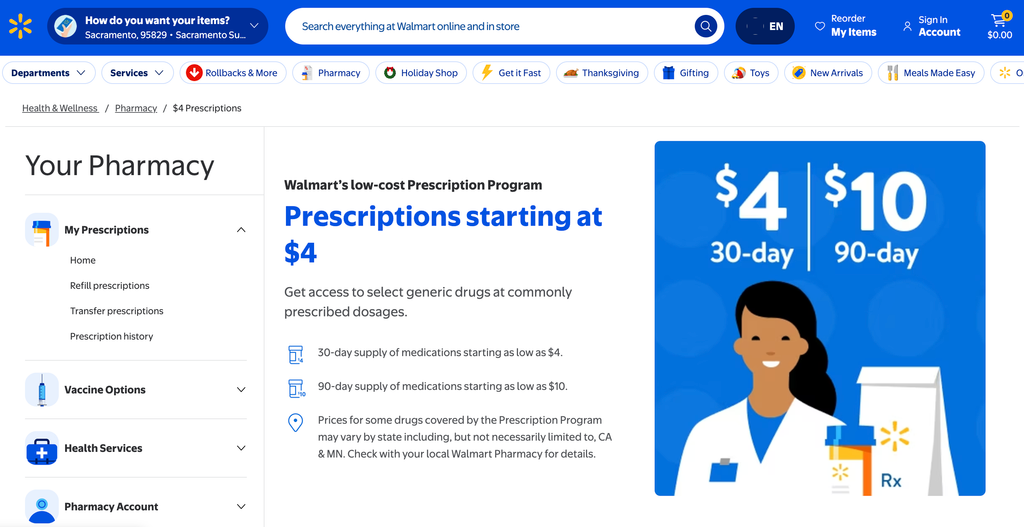
One of Walmart’s most useful savings opportunities is available behind the pharmacy counter rather than on the regular store shelves. Its low-cost prescription program offers selected generic medications at prices starting at just $4 for a 30-day supply.
This program is not limited to people over 60, and customers generally do not need Walmart+ or a separate membership to access its listed cash prices. That makes it worth checking for retirees who take several maintenance medications.
The program includes selected dosages of medications commonly prescribed for conditions such as high blood pressure and diabetes. However, not every generic drug, dosage, or manufacturer qualifies for the lowest price.
Consider a hypothetical retiree paying $18 each month for an eligible medication. If the same dosage is available for $4 through Walmart’s program, the difference would be $14 monthly, or $168 over a full year.
That is a meaningful reduction for someone managing expenses on a fixed income. Still, the saving depends on the actual medication, dosage, and price at the pharmacy.
What to do: Ask a Walmart pharmacist to compare your prescriptions against the current low-cost medication list. If you have Medicare Part D, compare the program’s cash price with your insurance copay and ask how paying cash affects your coverage costs.
2. The $10 Prescription Option May Save Money and Pharmacy Trips
Walmart’s prescription savings program also includes selected 90-day supplies starting at $10. This option can be especially convenient for older adults taking medications regularly throughout the year.
Three separate 30-day refills at $4 each would cost $12. A qualifying 90-day supply priced at $10 would cover approximately the same period for $2 less.
That difference might seem small until someone manages several prescriptions. The larger benefit may be fewer pharmacy trips and less time spent arranging refills.
Here is how the numbers compare under the assumption that each medication qualifies for both advertised prices.
| Eligible Medications | 30-Day Fills Per Year | Four 90-Day Fills | Annual Savings |
|---|---|---|---|
| 1 medication | $48 | $40 | $8 |
| 2 medications | $96 | $80 | $16 |
| 3 medications | $144 | $120 | $24 |
| 4 medications | $192 | $160 | $32 |
The direct savings are modest, but the convenience can matter more for someone with limited transportation or a busy medical schedule. Four prescriptions filled every 90 days can mean fewer refill transactions than monthly dispensing.
Not every prescription is appropriate for a 90-day supply. New medications, dosage adjustments, or insurance restrictions may require shorter fills.
Before changing your refill schedule, ask your prescriber and pharmacist whether a longer supply is appropriate. It is also worth checking whether your Medicare drug plan offers a competitive 90-day price.
3. Walmart+ Assist Offers Half-Price Memberships to Qualifying Households
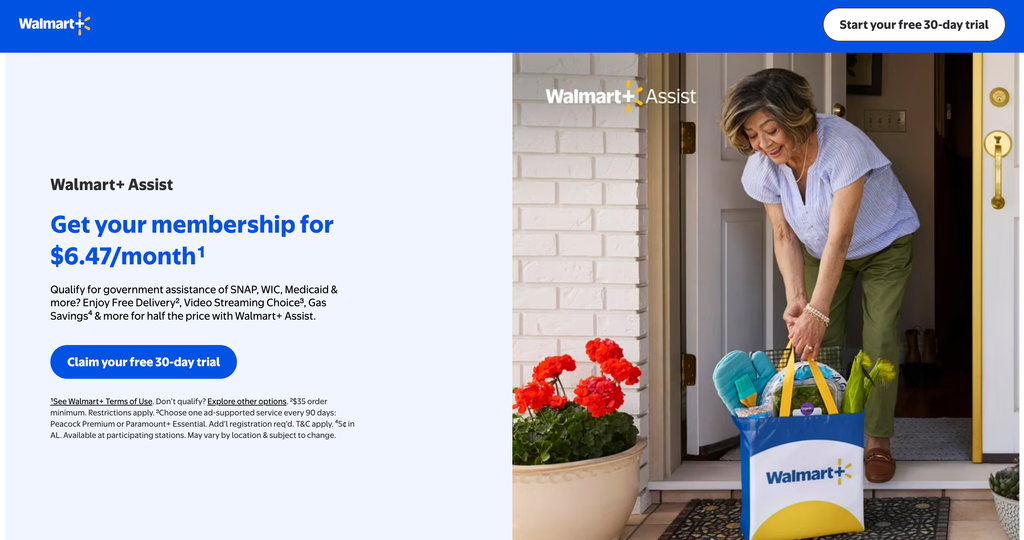
Walmart+ normally costs $98 annually, but qualifying customers can get Walmart+ Assist for $49 per year. That represents a $49 reduction in the annual membership fee before applicable taxes.
The important detail is eligibility. Walmart+ Assist is based on participation in qualifying assistance programs, not on being 60 or older.
Programs Walmart lists as qualifying include SNAP, Medicaid, Supplemental Security Income, Federal Public Housing Assistance, and certain veterans and survivors pension benefits. Other government assistance programs may also qualify.
This distinction matters because Social Security retirement benefits and Supplemental Security Income are different programs. Receiving regular Social Security retirement income does not automatically qualify someone for Walmart+ Assist.
Eligible applicants complete an identity and program verification process. Walmart currently uses a third-party verification service to confirm qualifying benefits.
The annual price is lower than the monthly payment option, which Walmart lists at $6.47 per month. Paying monthly for 12 months totals $77.64 before taxes, compared with $49 for an annual Assist membership.
For retirees who already use qualifying assistance programs, checking eligibility could be worthwhile. However, purchasing a membership makes sense only if its benefits are likely to exceed the cost.
4. AARP Members Can Save $40 on Walmart+ Every Year
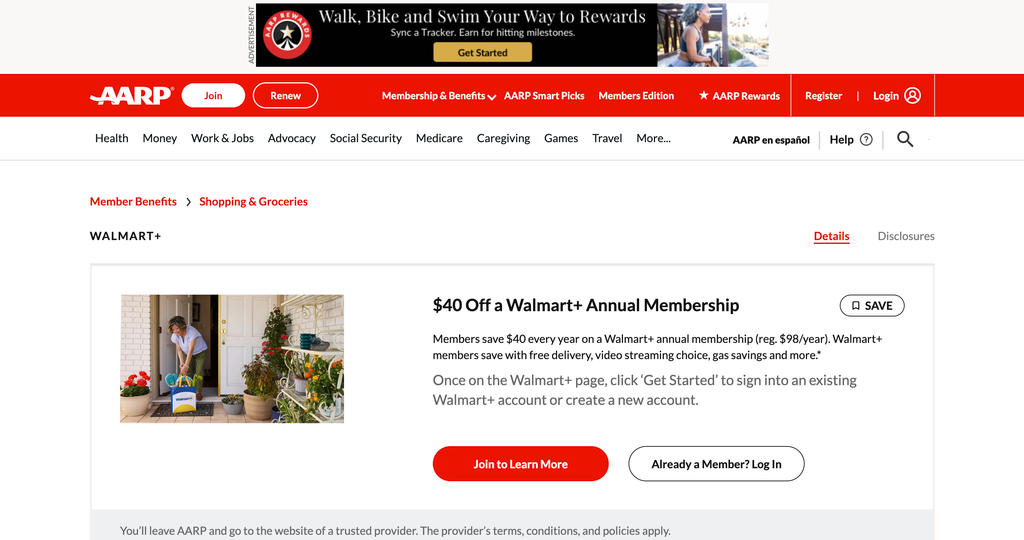
There is another discounted Walmart+ option that does not require enrollment in a government assistance program. AARP members currently have access to an offer that reduces the annual Walmart+ membership price by $40.
That brings the advertised annual cost from $98 to $58 before applicable taxes. AARP membership has its own cost, so someone joining solely for this offer should include that expense in the calculation.
AARP members need to activate the discount through the AARP member benefits process. Simply telling a Walmart cashier that you belong to AARP does not provide a discount on ordinary purchases.
The main membership choices are worth comparing before signing up. Each provides access to Walmart+ benefits, subject to the applicable terms.
| Membership Option | Annual Price | Eligibility |
|---|---|---|
| Standard Walmart+ | $98 | General customers |
| Walmart+ Assist | $49 | Qualifying assistance recipients |
| AARP Walmart+ offer | $58 | Eligible AARP members |
The prices are before tax, and AARP dues are separate from its discounted Walmart+ price. These membership offers are alternatives rather than discounts that can simply be combined.
For someone qualifying for Assist, the $49 annual option costs $9 less than the AARP offer. For someone already paying AARP dues who does not qualify for Assist, the $58 offer may be the better choice.
The question is not just which membership is cheapest. It is whether delivery, shipping, fuel discounts, and other benefits will save enough money to cover the annual fee.
5. Your Medicare Advantage Plan May Include a Walmart Grocery or OTC Allowance

Some retirees carry a Medicare Advantage benefit card without fully understanding what purchases it covers. Depending on the plan, that card may provide an allowance for eligible over-the-counter health products or groceries.
These benefits come from the insurance plan, not directly from Walmart. Walmart supports certain benefit payment cards, but acceptance, eligible products, and benefit amounts vary.
Some Medicare Advantage plans offer allowances for items such as vitamins, pain relief products, first aid supplies, or other approved health essentials. Grocery benefits can have additional eligibility requirements, including qualifying chronic health conditions.
Not every Medicare Advantage member receives a grocery allowance. Original Medicare does not provide a general Walmart grocery card either.
A hypothetical plan that offers a $50 monthly eligible grocery allowance could provide up to $600 in annual purchasing benefits. That calculation assumes the allowance is available every month, the member qualifies, and all funds are used before expiration.
However, some plans issue allowances quarterly, restrict eligible purchases, or do not carry unused balances forward. Shoppers need to check the actual plan documents rather than assume a benefit advertised elsewhere applies to them.
Call the number on the back of your Medicare Advantage card and ask whether your plan includes grocery or OTC benefits. Confirm whether Walmart accepts the card, which items qualify, and when the allowance expires.
6. The Truth About Walmart’s Supposed Secret Price Tag Codes

Online shopping advice frequently claims that the last two digits of a Walmart price reveal whether an item will become cheaper. Some guides suggest that prices ending in .00, .01, .03, or .88 carry special meanings.
These claims sound useful, but Walmart has not published a reliable, nationwide policy confirming those endings as universal clearance signals. A price ending in a particular number does not guarantee that the item has reached its lowest possible price.
Actual clearance opportunities are easier to identify through marked-down prices and clearance labels. The discount should be evaluated using the previous price, current selling price, and what similar products cost elsewhere.
Suppose a small kitchen appliance originally costs $40 and is reduced to $24. That is a $16 reduction, or 40%, regardless of whether its price ends in .00 or .88.
The catch is that a clearance label does not always mean the product is a bargain. A similar appliance from another brand might already sell for $22 without any promotion.
Older shoppers can use clearance sections to save money without memorizing supposed secret pricing rules. The useful habit is comparing the actual price and condition before deciding to buy.
7. The Walmart App Scanner Can Reveal Prices You Might Otherwise Miss
The free Walmart app includes a barcode scanner that allows customers to check product information and prices. It can also help shoppers locate items, review offers, and find participating products with manufacturer promotions.
This can be especially helpful when a shelf label is missing or several similar products are displayed together. Instead of guessing which price belongs to an item, shoppers can scan its barcode.
Walmart also provides a Store Mode feature that can show nearby store inventory and local shopping information. Prices may differ among stores, online listings, and third-party sellers.
However, a lower price displayed somewhere in the app does not automatically become the checkout price. A shopper may be viewing an online promotion, a different location, or a listing that does not qualify for an in-store price match.
Before checking out, confirm that the app is showing the intended store and the exact product. If the displayed price and shelf price differ, ask an associate to verify the current selling price.
The scanner can also help identify Walmart Cash manufacturer offers. That makes it useful for more than finding markdowns, particularly for shoppers buying the same household products regularly.
8. Damaged Packaging and Open-Box Merchandise May Be Cheaper

A torn cardboard box does not always mean the product inside is damaged. Some shoppers find worthwhile bargains on merchandise with imperfect packaging, cosmetic damage, or minor missing accessories.
Walmart stores can reduce prices on certain merchandise as part of inventory and clearance management. However, there is no verified nationwide guarantee that every damaged box qualifies for a specific percentage discount.
Imagine a patio chair with a small scratch on its frame. If a store is willing to reduce its price from $80 to $60, the customer saves $20 without necessarily sacrificing its intended function.
The key is separating cosmetic flaws from functional problems. A scratched storage bin is different from a damaged electrical appliance or an item missing an essential safety component.
Before purchasing, inspect the merchandise and verify what is included. Ask whether the item is sold as new, clearance, open-box, or another condition, and confirm the applicable return terms.
A discount becomes less attractive if the item requires expensive repairs or cannot perform the job you need. Prioritizing condition and usability is more valuable than chasing the largest percentage reduction.
9. Asking a Manager About a Markdown Can Sometimes Pay Off

Most shoppers assume the price displayed on the shelf is the only price available. In some situations, a store manager may have authority to reduce prices on excess stock, seasonal items, or merchandise with noticeable defects.
Walmart acknowledges that individual stores may lower prices to clear inventory or respond to local market conditions. However, that does not mean every manager can or will negotiate on demand.
A reasonable approach is to ask politely about a specific problem. For example, an item missing an accessory or showing visible damage may be worth discussing before purchasing.
There is no verified nationwide promise of an extra 10% to 25% discount, a fixed monthly markdown budget, or a particular day when managers offer better prices. Those claims should not be treated as established store policy.
Several popular Walmart savings claims are worth separating from the actual rules. The distinction can prevent unnecessary purchases and frustration at checkout.
| Common Claim | What Is Reliable | Better Action |
|---|---|---|
| Certain price endings mean final clearance | No universal code confirmed | Compare actual prices |
| Managers always give extra discounts | Discounts are discretionary | Ask about a specific defect |
| Clearance follows a fixed schedule | Timing varies by store | Check when convenient |
| The app price is always honored | Price match restrictions apply | Verify item eligibility |
The most useful approach is to ask questions without assuming the answer will be yes. Even when no additional markdown is available, you may learn whether the item is expected to be restocked or further reduced.
For retirees with flexible shopping schedules, comparing local prices can also be worthwhile. It is simply better not to spend more on transportation or unnecessary purchases than the discount would save.
10. Bakery, Meat, and Produce Markdowns Can Reduce Grocery Costs

Fresh food is one of the largest recurring expenses in many household budgets. Checking marked-down groceries can make a noticeable difference, particularly for shoppers who can prepare or freeze food soon after purchasing.
Walmart stores may reduce prices on selected bakery items, produce, or meat as products approach their sell-by or best-by dates. The timing and size of these reductions vary by store and inventory.
There is no confirmed nationwide rule that Walmart marks down all fresh foods after 5 p.m. Some locations may reduce products earlier, while others may have limited discounted inventory on a particular day.
A realistic example shows why the opportunity matters. If a shopper regularly buys a $14 package of chicken and finds an equivalent package for $9, the difference is $5.
Finding that reduction twice per month would save $120 over a year. That is a hypothetical calculation, not a promise that those markdowns will be available.
Food safety still matters more than the discount. Check packaging, storage conditions, and product dates, and refrigerate or freeze perishable foods promptly.
A useful strategy is to plan meals around discounted products that can be safely used. Buying twice as much food merely because it is marked down is not a saving if half of it eventually gets thrown away.
11. Walmart Still Matches Certain Prices From Its Own Website

One Walmart policy that can produce a direct checkout saving is its in-store price match program. Under its published policy, participating U.S. stores may match the Walmart.com price of an identical eligible item.
The product generally must be sold by Walmart and currently available on Walmart.com. The item must match in important details such as brand, size, model, and quantity.
There are exclusions, including third-party Marketplace sellers and certain special online promotions. Walmart does not generally match competitors’ prices or prices at other Walmart locations.
Suppose a household item costs $28 in a store but the identical, qualifying Walmart.com product is advertised for $23. An approved price match would save $5.
For someone shopping regularly, occasionally finding these differences could help reduce spending. However, the saving is not automatic, and the store manager has final authority under Walmart’s policy.
Ask for the price match at checkout and show the current Walmart.com listing. Do not assume an online clearance or limited-time deal will qualify.
The distinction between regular online prices and special promotions matters. A shopper who understands these restrictions is less likely to rely on a discount that cannot be applied.
12. Walmart+ Members Can Save on Gas at Participating Stations
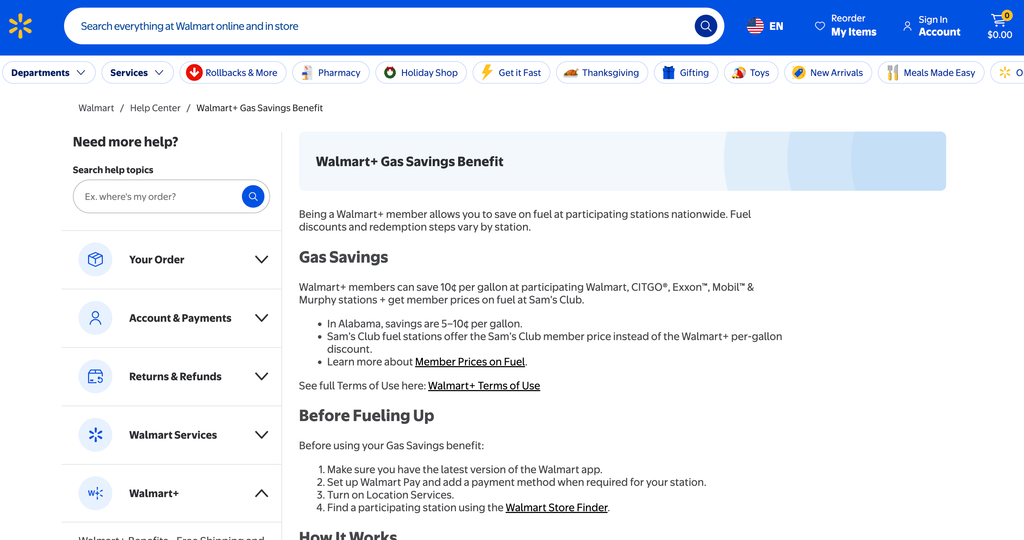
Fuel costs often receive less attention than grocery bills, even though they can add up over a year. Walmart+ members have access to fuel savings at participating stations, including Walmart, Murphy, Exxon, Mobil, and CITGO locations.
The advertised benefit is generally 10 cents per gallon at eligible locations, with some differences in Alabama. Sam’s Club fuel locations provide member pricing rather than the same flat per-gallon discount.
The savings depend on how much a person drives and how often they use participating stations. For someone living near an eligible station, the discount may be convenient to use regularly.
Consider a hypothetical retiree who buys 30 gallons of eligible fuel every month. At 10 cents per gallon, that equals $3 monthly, or $36 annually.
That amount alone would not cover the $49 annual Walmart+ Assist membership. However, the calculation changes if the person also uses delivery and other membership benefits.
The best decision depends on the total value of the membership rather than fuel savings alone. Driving several extra miles to reach a participating station could also reduce or eliminate the benefit.
Members generally activate the fuel benefit through the Walmart app or the participating station’s required process. Checking the station’s eligibility before driving there is a sensible precaution.
13. Walmart Cash Offers May Be Sitting in Your Account
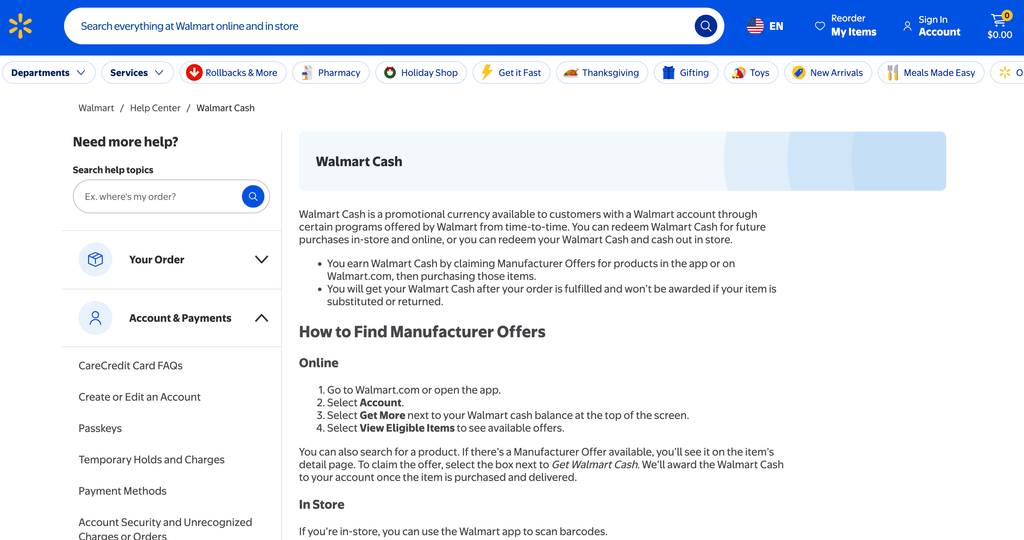
Walmart Cash is a promotional rewards program that can provide credits after eligible purchases. Certain manufacturer offers must be claimed through Walmart’s app or website before the applicable transaction.
For shoppers who regularly buy participating products, these offers may provide savings on items already included in their household budget. Unlike a general store discount, the earning amount varies by promotion.
Walmart Cash can be applied toward eligible Walmart purchases. Under the published program rules, customers who accumulate at least $25 can also request cash redemption in-store.
That cash-out process requires a generated barcode and identity verification at a participating Walmart MoneyCenter or customer service desk. It is not simply a matter of asking any cashier to hand over cash.
For example, someone earning $4 in Walmart Cash each month would accumulate $48 over a year, assuming all credits are earned and retained. That calculation does not mean every shopper will receive $4 monthly.
The mistake is assuming rewards build automatically from every purchase. Walmart Cash normally requires qualifying purchases, and certain manufacturer offers require activation.
What to do: Open your Walmart account and check the current Walmart Cash balance and available manufacturer offers. Before buying an item for its reward, compare the final cost after the offer with the price of a suitable alternative.
14. Curbside Pickup, Delivery, and Free Shipping Have Different Rules

Walmart offers several ways to shop without carrying purchases through the store. These options can be useful for older adults who want to reduce heavy lifting, save time, or avoid making additional shopping trips.
However, the distinction between pickup, delivery, and shipping is important. Walmart does not universally promise free curbside pickup with no minimum purchase.
Under its published shopping information, standard pickup orders of at least $35 generally qualify for free pickup. Smaller orders may incur a minimum-order fee.
Walmart+ members can receive free shipping on eligible items without a minimum order. That shipping benefit is different from scheduled grocery delivery and curbside pickup.
For scheduled delivery from a local store, the usual free-delivery threshold is $35. Walmart’s membership terms also describe certain eligible unscheduled deliveries without that minimum, so the final checkout terms matter.
Members may also qualify for free delivery of eligible prescriptions without an order minimum. Availability depends on the location, medication, and delivery service.
For someone who struggles with carrying bulky products, curbside pickup may be useful even when it does not produce a direct price reduction. A Walmart associate typically brings the order to the designated pickup location.
The key is to check the cart before confirming an order. Delivery charges, minimum-order fees, and other service fees can quickly consume a small product discount.
How Much Could These Walmart Savings Actually Add Up To?
The 14 opportunities do not all apply to every shopper, and some are different ways to use the same membership. Adding every advertised benefit together would therefore overstate the amount an individual could save.
A more realistic approach is to calculate savings from purchases a person already makes. The following examples use hypothetical spending patterns and assume each discount is available and actually used.
| Savings Opportunity | Assumption | Potential Annual Benefit |
|---|---|---|
| Prescription pricing | $14 less per month | $168 |
| Fuel discount | 30 gallons monthly at 10¢ less | $36 |
| Grocery markdowns | $5 saved twice monthly | $120 |
| Walmart Cash | $4 earned monthly | $48 |
| Total | Combined hypothetical savings | $372 |
The $372 represents possible savings before subtracting any membership costs. It excludes Medicare Advantage allowances because those depend heavily on individual eligibility and plan benefits.
If this hypothetical shopper paid $49 annually for Walmart+ Assist and none of the benefits overlapped, the net figure would be $323. Actual results could be much lower or higher depending on purchases and program eligibility.
An important point is that the largest saving may come from a single regular expense. Someone paying more than necessary for an eligible prescription could save more than another shopper who spends hours searching clearance racks.
A Simple Walmart Savings Checklist for Your Next Visit
Trying to use all 14 opportunities during one trip is unnecessary. A better approach is to check the programs most relevant to your existing spending.
Start with recurring expenses, especially prescriptions, groceries, and transportation. These categories offer more opportunities for repeated savings than occasional purchases of discounted merchandise.
| Priority | What to Check | Next Step |
|---|---|---|
| First | Prescription prices | Compare cash and insurance costs |
| Second | Walmart+ eligibility | Check Assist and AARP offers |
| Third | Insurance benefits | Verify grocery and OTC allowances |
| Fourth | Store prices | Use the app and review eligible matches |
| Fifth | Rewards and services | Check Walmart Cash and delivery fees |
This process also helps avoid one common spending mistake: purchasing something unnecessary just because the discount looks attractive. Saving $15 on an item you never intended to buy still means spending money.
A written shopping list and a quick price check can work together. The list controls what enters the cart, while the price check helps lower the cost of those planned purchases.